Preview: ⛰️ OYAMA’s History Walks #1: Tokyo International Forum Glass Building 💎
OYAMA’s History Walks starts here!
For the first walk, we’re heading right into the middle of Tokyo — to the Glass Building at the Tokyo International Forum in Yurakucho.
It’s a huge structure made of glass and steel.
And we’re going to dig into the history and industry underneath it.
This was also the place where the Olympic flame relays from around Japan came together during the 1964 Tokyo Olympics.
Contents
The Glass Building?
The Geological History of Marunouchi
Ota Dokan and the Yamabuki Flower
Civil Engineering: Cutting Down a Mountain to Fill the Sea
Daimyo Mansions → Government Offices → Glass Ship
Highlights of the Glass Building
Bonus: Anime Connections
Industry in Marunouchi
Timeline: What Was Happening in Asia and the World?
How to Get to the Tokyo International Forum
The Glass Building?
The Tokyo International Forum is right outside Yurakucho Station and about a five-minute walk from Tokyo Station.
It’s a huge cultural complex that hosts around 4,000 events a year, including concerts, international conferences, musicals, and more.
The part that really stands out is the Glass Building — a giant structure that looks a little like a ship made of glass.
Architect: Rafael Viñoly, a Uruguay-born architect who worked in New York
Opened: January 10, 1997
Atrium height: about 60 meters
Glass panels: about 3,600
Awarded three stars in the Michelin Green Guide Japan
And the best part?
It’s free to enter.
The building is open from 7:00 a.m. to 11:30 p.m.
▶ Tokyo International Forum Official Website
The Geological History of Marunouchi
Today, Marunouchi looks like one of Japan’s ultimate business districts.
But originally?
It was the sea.
The area changed something like this:
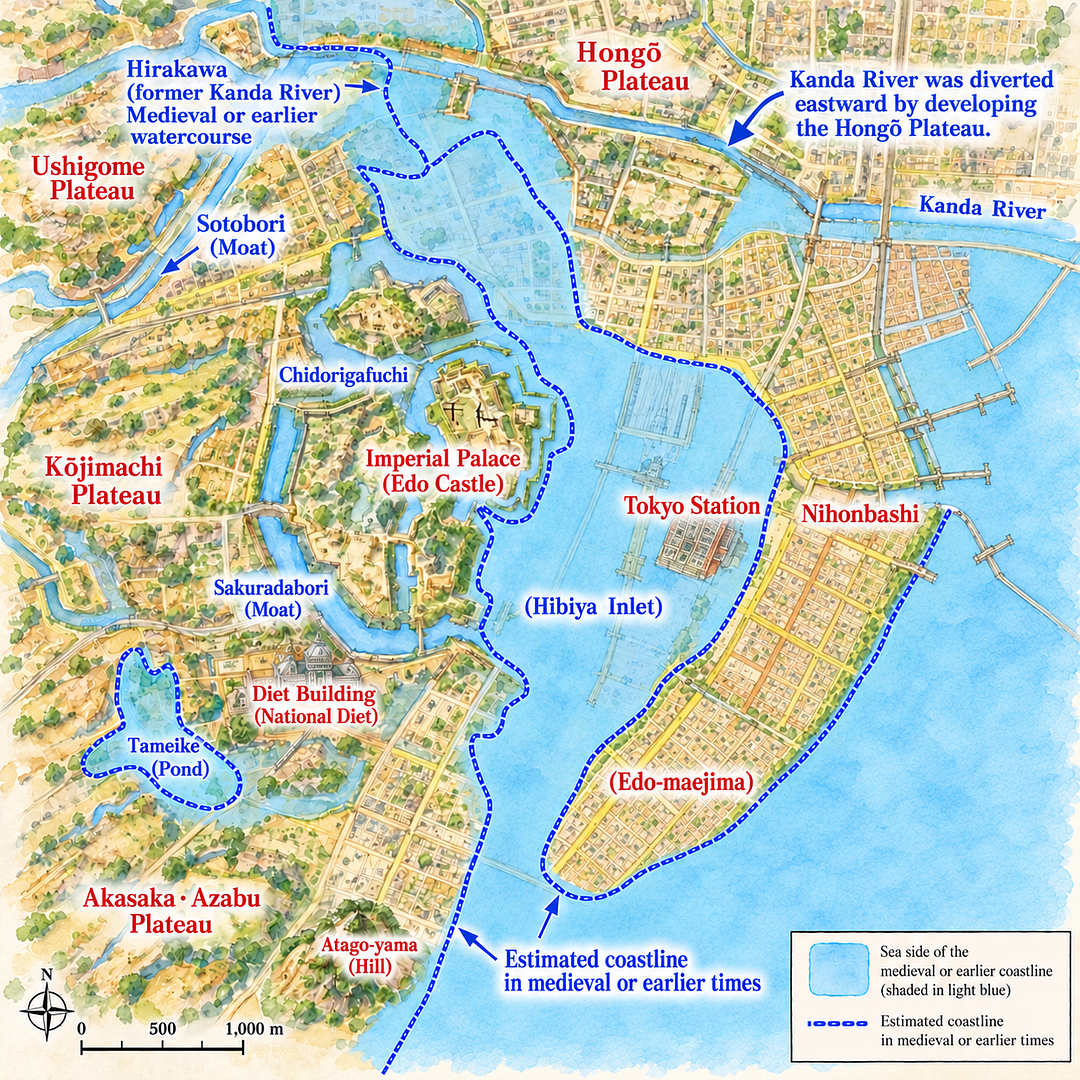
Around 20,000 years ago — Ice Age: Sea levels were more than 100 meters lower than today, and most of Tokyo Bay was dry land. A river ran through the valley.
Around 6,000 years ago — Jomon period: Ice melted, sea levels rose, and the sea pushed far inland. This is known as the Jomon Transgression.
Later: The sea retreated somewhat, leaving a shallow inlet stretching from around today’s Marunouchi toward Shimbashi. This was called the Hibiya Inlet.
Around modern Ginza: Sand accumulated and created a long, narrow peninsula known as Edo-maejima.
So the Glass Building stands roughly around the old boundary between an inlet and a sandy peninsula.
Ginza: once a sandy shore.
Marunouchi: once the sea.
There’s also a slope in the East Gardens of the Imperial Palace called Shiomizaka, or “Tide-Viewing Slope.”
When Edo Castle was first built, you could apparently see the sea from partway up the slope — which is how it got the name.
But as land reclamation continued, that view disappeared within a few decades.
You could call that false advertising.
But the slope didn’t exactly ask to lose its ocean view, so maybe we should leave it alone.
Ota Dokan and the Yamabuki Flower
On the first floor of the Glass Building, on the Tokyo Station side, there’s a bronze statue of a samurai dressed for hunting.
A man from the Muromachi period standing alone inside a futuristic world of glass and steel, surrounded by international tourists.
I’m a little worried about him.
This is Ota Dokan, a historical figure whose statues can be found around Tokyo.
He built the first Edo Castle in 1457 — more than 130 years before Tokugawa Ieyasu arrived in Edo.
He was a Kanto warlord during the Muromachi period and served as karei, or chief retainer, of the Ogigayatsu Uesugi family. A karei basically handled political administration on behalf of the lord — something like the head of operations.
The castle Dokan built on the plateau beside the Hibiya Inlet became the beginning of what is now the Imperial Palace.
He is also said to have welcomed and protected shrines around Edo Castle. One theory says that Akasaka’s Hie Shrine began when Dokan brought the Sanno deity from Kawagoe.
The Ordinary Girl Who Supposedly Changed Dokan
One of the most famous stories about Dokan is the Yamabuki story.
Dokan is out hunting when a sudden rain starts.
He stops at a nearby house and asks to borrow a mino, a traditional straw raincoat.
A young girl comes outside, says nothing, and simply hands him a branch of yamabuki flowers.
Dokan leaves irritated: “I asked for a raincoat, and she gave me flowers...?”
Fair enough.Later, one of his retainers explains that she was referring to an old waka poem.
The poem goes:
Seven-fold, eight-fold,
the yamabuki blooms —
yet sadly,
not even a single fruit
does it bear.
The joke is based on the word mi.
Yamabuki flowers bloom beautifully, but traditionally were said not to bear fruit — mi.
And mino, the word for the raincoat Dokan asked for, sounds similar.
So through poetry, the girl was elegantly saying:
“I’m sorry, but we don’t even have one raincoat to lend you.”
Dokan was embarrassed that he hadn’t understood.
According to the story, he began studying waka poetry seriously after that and eventually became known as an accomplished poet.
Maybe knowing culture and manners was one of the shortcuts to getting ahead back then.
And instead of ending the story with:
“How was I supposed to understand that?”
he actually went and studied.
That might be why he became the historical figure and I’m the one writing about him.
The person who inspired this warlord to learn was a local girl whose name wasn’t even recorded.
The fact that the statue in the Glass Building shows Dokan dressed for hunting is also often connected to this Yamabuki story.
The statue itself was created by sculptor Fumio Asakura.
It was made in 1956 to commemorate the 500th anniversary of the opening of Edo-Tokyo and originally stood in front of the old Tokyo Metropolitan Government Building.
After the metropolitan government moved to Shinjuku, the statue returned here in 1996.
Even today, Dokan stands facing toward Edo Castle — today’s Imperial Palace.
Since 2017, a model of Edo Castle and explanatory panels have also been displayed beside him.
Side Trip: Asakura Museum of Sculpture in Yanaka
Fumio Asakura’s former studio and residence still exists in Yanaka as the Asakura Museum of Sculpture.
The current building was designed by Asakura himself in 1935.
The building is a nationally registered Tangible Cultural Property, while the entire site is designated as a national Place of Scenic Beauty.
You can experience the sculptures, architecture, and garden together.
It’s a beautiful mix of Japanese and Western styles.
Address: 7-18-10 Yanaka, Taito City
Access: About 5 minutes on foot from Nippori Station — exit through the North Gate and use the West Exit
Hours: 9:30–16:30, last admission at 16:00
Closed: Mondays and Thursdays, or the following weekday when those days are holidays; also closed during the New Year period and other dates
Admission: ¥500 for adults / ¥250 for elementary, junior-high, and high-school students
You remove your shoes inside, so wear socks
And while we’re talking about Nippori — there’s another statue of Ota Dokan on horseback near Nippori Station.
The area is said to have been one of the places where Dokan often went falconry hunting.
Civil Engineering: Cutting Down a Mountain to Fill the Sea
Tokugawa Ieyasu arrived in Edo in 1590.
When he established the shogunate in 1603, the massive makeover of Edo began.
One major system was called Tenka Bushin — large construction projects ordered from daimyo across Japan.
Who paid?
Basically, the daimyo who were ordered to participate.
They had to supply workers and materials based on the size of their domains, measured in koku.
For example, when the Horikawa canal in Nagoya was dug, the rule was reportedly:
one worker for every 1,000 koku.
For Fukushima Masanori, whose domain was valued at 498,000 koku, that alone meant nearly 500 workers.
Apparently, some daimyo were not exactly thrilled about this arrangement.
One theory is that forcing daimyo to spend money and manpower building the shogun’s castles and cities also weakened their ability to rebel.
Some daimyo even deliberately transported enormous stones to construction sites as a way of showing their loyalty to the Tokugawa.
Around Marunouchi, the process went like this:
Around 1592: Reclamation of the Hibiya Inlet began using soil removed during construction of Edo Castle’s West Citadel.
From 1603: Work intensified. A hill called Kanda-yama, around modern Ochanomizu and Surugadai, was cut down and the soil used to fill the inlet.
Around 1620: Date Masamune was placed in charge of digging an artificial valley in Ochanomizu to change the course of a river. The remaining soil went into the inlet too.
Did you know there used to be a mountain in Kanda?
Even online, people react with:
“There was a mountain in Kanda!?”
It was actually more of a hill or plateau around modern Ochanomizu and Surugadai, connected to the Hongo Plateau to the north.
It’s estimated to have been around 25 meters above sea level — roughly the height of an eight-story building.
There are claims online that it was 300 meters high.
Considering how much soil was actually removed, that seems... unlikely.
The shogun and daimyo gave the orders.
But the people actually carrying soil again and again in mokko, traditional carrying baskets, were ordinary workers gathered from around Japan.
Dig.
Carry.
Dump.
Dig again.
Filling the Hibiya Inlet alone took roughly 30 years, from around 1592 into the 1620s.
The overall construction of Edo Castle and the surrounding city continued for more than 40 years, until the outer moat was completed around 1636 under the third shogun, Iemitsu.
Very few records remain telling us exactly how many people worked there or how much they were paid.
What remains is the ground.
Today, hundreds of thousands of people stand on top of it every day.
Almost nobody thinks about what’s underneath their feet.
Then again, the ground doesn’t collapse just because you forgot to think about it.
Daimyo Mansions → Government Offices → Glass Ship
The land where the Tokyo International Forum stands has changed roles again and again.
Edo period | Daimyo mansion district
Prime land directly in front of Edo Castle was lined with daimyo residences. The area was known as Daimyo Koji, or “Daimyo Lane.”1894 | Tokyo Prefectural Office built
For roughly the next 100 years, this area became one of the centers of Tokyo’s government.1945 | Government buildings destroyed in air raids
1957 | Old Tokyo Metropolitan Government Building
A new government complex designed by architect Kenzo Tange was completed.1964 | The Olympic flame arrives
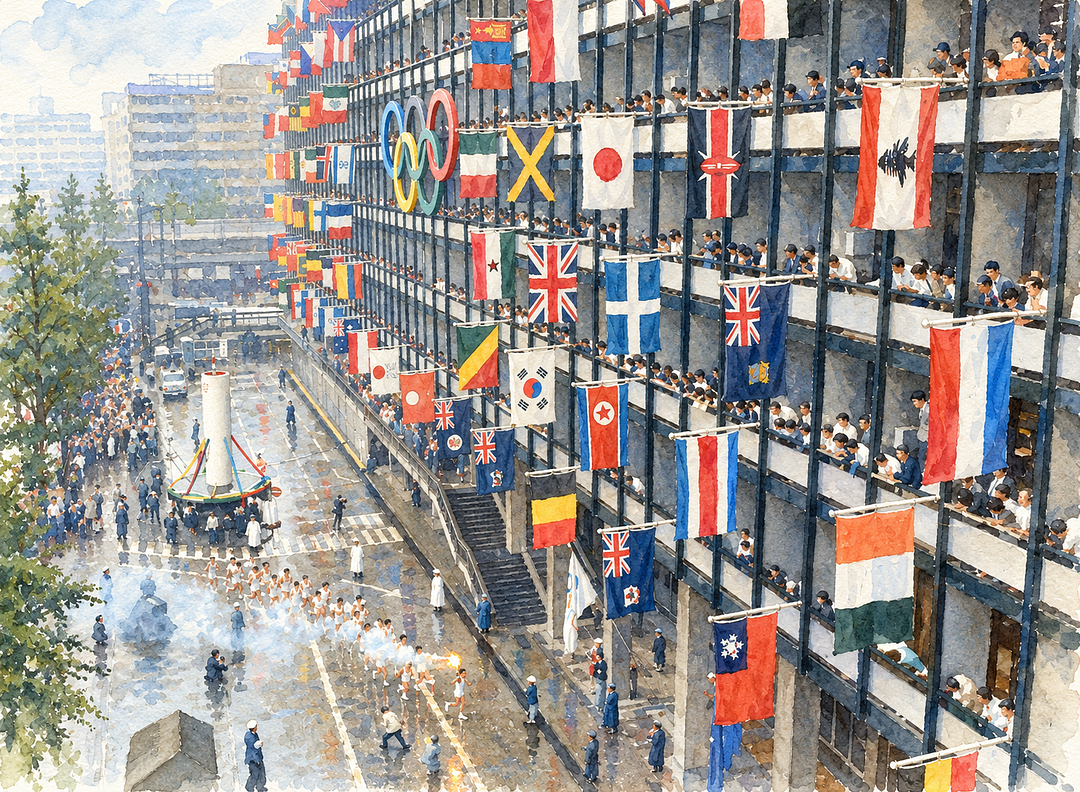
During the Tokyo Olympics, torch relays traveling along four routes across Japan converged here. The government building was decorated with Olympic rings and international flags.Old photographs show Tange’s Metropolitan Government Building facing Kajibashi-dori with a long facade covered in flags, along with a white tower marked “Olympic Torch Relay Arrival Ceremony.”
Torch runners arrived along the road in front of what is now the Glass Building, on the Tokyo Station side.
The Tokyo Olympics opened on October 10. That date later became the national holiday Health and Sports Day, which eventually became today’s Sports Day.
1989 | Japan’s first UIA-approved international architectural competition
Designs came in from around the world, and Rafael Viñoly’s proposal was selected.1991 | Tokyo Metropolitan Government moves to Shinjuku
The Marunouchi government buildings had become old, cramped, and inconvenient, with operations spread across as many as six buildings.Tokyo’s population “center of gravity” was also moving west as the Tama area developed, and there was a huge available site west of Shinjuku Station where the Yodobashi Water Purification Plant had once stood.
1997 | Tokyo International Forum opens
2021 | Tokyo 2020 Olympics
The venue hosted the Olympic weightlifting competition.
Sea → land → daimyo mansions → government offices → a public plaza.
That’s quite a career change for one piece of land.
Highlights of the Glass Building
The giant glass roof: About 208 meters long. It looks like the bottom of a ship turned upside down, with steel beams lined up almost like fish bones.
Two giant columns: Each is around 50 meters tall. Just two columns support roughly 2,500 tons of roof steel. That’s about the weight of 400 elephants.
250 kilometers of welding: Every connection in the steel frame was welded. Added together, the welding would stretch around 250 kilometers — enough to go from Tokyo to beyond Shizuoka.
7th-floor walkway: A dramatic place to see the ship-bottom and keel-like structure up close.
Ota Dokan statue: First floor, Tokyo Station side. You’ll also find the model of Edo Castle and explanation panels nearby.
Ground-level plaza: A tree-filled plaza between the Glass Building and Hall Building. On weekday lunchtimes, food trucks gather for Neo Yataimura. Antique markets and other events are also sometimes held here. Check the official website for current schedules.
By the way, construction of the Tokyo International Forum cost about ¥165 billion, excluding the land.
That’s reportedly more than the current Tokyo Metropolitan Government Building in Shinjuku, which is often said to have cost around ¥157 billion.
Viñoly pushed glass and steel so far with this design that the building is sometimes described as one of the world’s most expensive buildings to construct.
In the morning, light comes in from the Yurakucho side and creates beautiful shadows across the glass and steel.
At night, the city lights reflect in the glass and the whole place takes on a futuristic atmosphere.
If you take photos there, share them in the comments!
And if you’re planning to visit, save this article and check some of these details while you’re there.
Just make sure to follow the building’s photography rules and avoid getting in the way of events or other visitors.
The Mitsuo Aida Museum also used to be located underground here, but it closed in January 2024 as part of large-scale renovation work.
I actually went there!
Tokyo International Forum Glass Building — Reference Videos
YouTube Shorts
https://youtube.com/shorts/QdPATBiispg?si=9upjJRpVD8LfUx6D
Bonus: Anime Connections
ONE PIECE
The manga began serialization in 1997 — the exact same year the “glass ship,” the Tokyo International Forum’s Glass Building, opened.
In the ONE PIECE world, the Thousand Sunny is listed as around 39 meters long and 56 meters tall.
The Going Merry is said to be roughly one-third the size.
The Glass Building’s giant roof is about 208 meters long.
So you could line up a little more than five Thousand Sunnys, or more than 15 Going Merrys.
That is important architectural information.
Probably.
Princess Mononoke
Princess Mononoke was also released in 1997.
The story is set during the Muromachi period — the same broad historical era in which Ota Dokan built Edo Castle.
There’s also an interpretation that the film contains a much larger theme: a clash between the Jomon-style “mura,” or village culture, and the “kuni,” or state-based society that developed after the Yayoi period.
Rather than simply deciding which side is right, maybe one of the most interesting parts of the movie is watching Ashitaka, San, and the other characters struggle while caught between competing worlds.
The environmental issues reflected in the story also gave the movie strong relevance at the time.
It became a record-breaking hit in Japan with around 14.2 million admissions and approximately ¥19.3 billion in box-office revenue.
It surpassed E.T., which had previously held Japan’s all-time box-office record including foreign films, and became the country’s biggest hit at the time.
It was released in the United States in 1999.
The initial release was tiny — only eight theaters — but the film has been re-released many times since.
Worldwide box-office revenue, including Japan, has now exceeded US$230 million, or roughly ¥34 billion.
Godzilla — 1954
The original Godzilla walks through the Ginza and Yurakucho area in the 1954 movie.
Today, nearby Hibiya has Hibiya Godzilla Square, complete with a Godzilla statue.
MAPPA EXPO 15th Anniversary
The MAPPA EXPO 15th Anniversary exhibition is being held at the YURAKUCHO MUSEUM on the B1 floor of the Tokyo International Forum.
The exhibition celebrates 15 years of anime studio MAPPA and features worlds connected to titles including:
Chainsaw Man – The Movie: Reze Arc
Attack on Titan The Final Season
JUJUTSU KAISEN
and more
Dates: September 16 – December 7, 2026
First half: September 16 – October 25
Second half: October 28 – December 7
Closed October 26 and 27
Some exhibits change between the first and second halves
Hours: 10:00–18:00
Last admission: 17:00
Tickets: Timed-entry system. Check the official website for ticket details and prices.
After Tokyo, the exhibition is also scheduled to travel to Fukuoka. Check the official website for the dates.
In October, Tom Cruise, who was visiting Japan to promote DIGGER, and Academy Award-winning director Alejandro G. Iñárritu also visited the exhibition.
Apparently, both of them were having a pretty good time.
I went to MAPPA EXPO too
Here are a couple of reference videos.
Spoiler warning!
YouTube Shorts
https://youtube.com/shorts/xbHuRnivKR0?si=9Y856k81N9IDxD87
Industry in Marunouchi
The Tokyo International Forum is located in Marunouchi 3-chome, Chiyoda City.
The Population and Economic Scale of Chiyoda
Population: 68,835 as of January 2025 according to the Basic Resident Register. The 2020 census recorded 66,680, so the population has been gradually increasing. Around 17% are aged 65 or older.
Daytime population: 903,780 according to the 2020 census — about 13.6 times the resident population. That means more than 800,000 people effectively enter the city every morning for work or school.
Business establishments: 35,990 in 2021
People working at establishments in the city: 1,111,656 in 2021
Sales generated by establishments in the city: about ¥110 trillion for 2020, according to an estimate by the Ministry of Economy, Trade and Industry. That ranked second among 815 cities and wards in Japan, behind Minato City.
Wholesale and retail sales: about ¥45 trillion — number one in Japan
Factory shipment value: about ¥61.2 billion — ranked 587th nationally
So, not exactly a factory town.
Workers by Industry
These figures come from the 2021 Economic Census and cover the 1,111,656 people working at establishments in Chiyoda City.
Chiyoda has far more people coming in to work than actually living there.
So rather than looking at the occupations of residents, I used data for people working at businesses located in Chiyoda.
Want to keep reading? Continue with the full article in the Premium 💎💬 Free Talk space 🙏
#⛰️ OYAMA’s History Walks #1: Tokyo International Forum Glass Building 💎