Preview: 📝 Notes on Work from the Front Line #2: Looking Back at the Industrial Revolution 🚂
Contents
A History of Human Revolutions
How the Industrial Revolution Began
A Barber and a Young Miner Became the Stars
The Industrial Revolution in Growth Rates
Talent and Character
The Tracks Go On and On
Final Thoughts
A History of Human Revolutions
Do you know how many “great revolutions” in human history are said to have completely changed the way we see the world?
Let’s take a quick look.
1. The Cognitive Revolution — about 70,000 years ago
Homo sapiens developed complex language and abstract thinking.
People became able to believe in and share myths and other things that could not be seen.
Because of that, it is thought that even strangers became able to cooperate in large groups.
This idea became especially well known through Harari’s Sapiens.
2. The Agricultural Revolution — from about 10,000 years ago
People who had lived by hunting and gathering began cultivating fields and raising animals.
They settled in one place, populations grew, and people became able to store food they could not immediately eat.
Those surpluses eventually became the foundation for social classes, inequality, and states.
3. The Birth of Cities and Writing — around 3500–3000 BC
City-states emerged in Mesopotamia and Egypt.
Writing was invented to record taxes and trade.
Government administration, laws, and written historical records all began around this period.
Apparently, the earliest writing wasn’t poetry.
It was bookkeeping. 😢
4. The Scientific Revolution — 16th–17th centuries
Copernicus, Galileo, Newton, and others established ways of explaining the world through observation, experimentation, and mathematics.
An attitude of:
“Admit what you don’t know, and investigate it.”
That became an engine for the technological progress that followed.
Looking at these revolutions together, I think you can see that many of humanity’s biggest changes involved changing the way we handle information.
We shared information through language.
Recorded it through writing.
Tested it through science.
And after all of that came the Industrial Revolution.
How the Industrial Revolution Began
The story goes back about 250 years.
Around 1760, the Industrial Revolution began in Britain.
Steam engines started running, and machines began taking over work that had previously been done by people and horses.
Cloth could be woven many times faster, and railways began carrying people and goods over long distances.
Actually, the steam engine itself existed before the Industrial Revolution.
In 1712, Thomas Newcomen in England built a steam engine to pump water out of coal mines.
But although it consumed large amounts of coal, it was not very powerful.
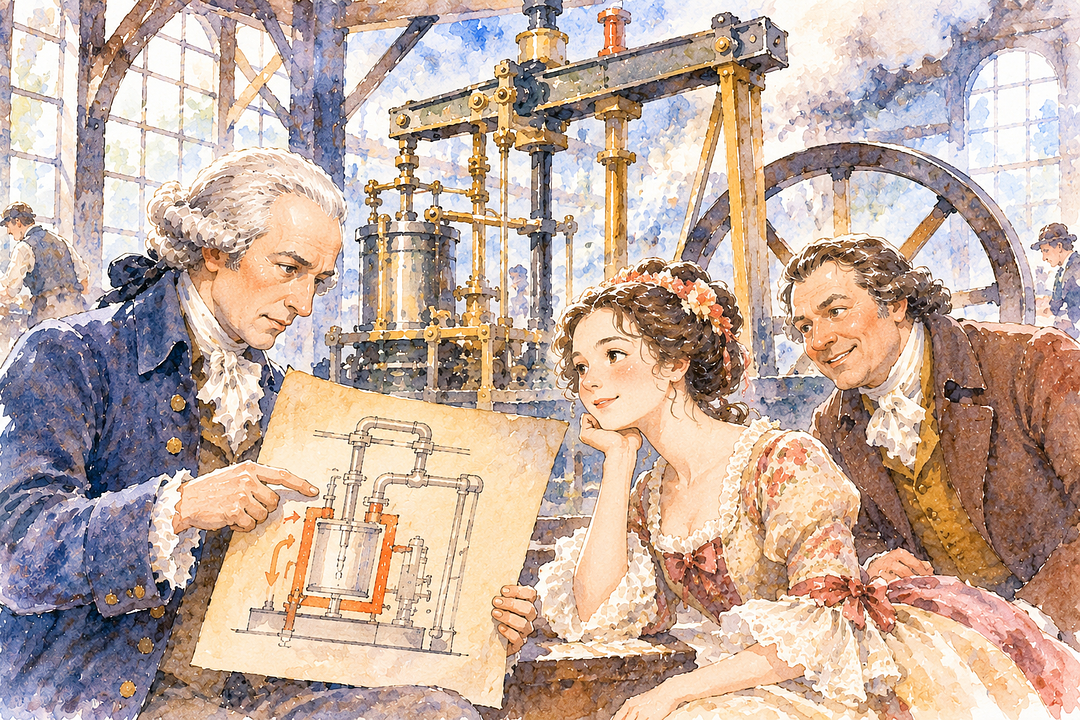
The person who made a major improvement was Scotland’s James Watt.
In 1769, he patented a system that reduced wasted heat, allowing steam engines to produce more power while using less fuel.
He then partnered with businessman Matthew Boulton to mass-produce the engines, and by the 1780s they had also developed rotary motion capable of turning wheels.
This meant steam engines could power not only pumps, but factory machinery as well.
The “watt” in something like a 60-watt light bulb comes from his name.
The major transformation in Britain is often said to have settled down around 1840.
From beginning to stabilization, roughly 80 years.
From there, the Industrial Revolution spread across Europe, America, and eventually Meiji-era Japan.
Factories and railways became normal parts of life around the world by roughly the beginning of the 20th century.
Counting from the start, that means it took around 150 years for the world to fully absorb and settle into the change.
I think what the Industrial Revolution transformed was:
the power to make things
and
the power to move things.
From there, the way people worked changed.
Where they lived changed.
Even the shape of families changed.
People who had once farmed in villages began working in factories in cities.
Even something we now consider completely normal — gathering at a fixed time and working according to a schedule — spread widely during this period.
And now, another major transformation is happening.
The Digital Revolution.
Computers.
The internet.
Smartphones.
And AI.
This time, what changed was:
the power to create information
and
the power to move information.
It has only been around 30 years since the internet became widespread.
Measured on the scale of the Industrial Revolution, maybe we are still only in the first half.
Thirty years ago, speaking with family overseas meant paying for expensive international phone calls.
Now, if you have a smartphone, you can talk face to face almost for free.
A lot of people probably video call their families back home every day.
And there is already a generation growing up for whom this technology has simply existed from birth.
Maybe even the phrase “digital native” is starting to sound old.
A Barber and a Young Miner Became the Stars
The Industrial Revolution took away a lot of people’s jobs.
Many craftsmen who had woven cloth by hand lost work to machines, and their incomes dropped sharply.
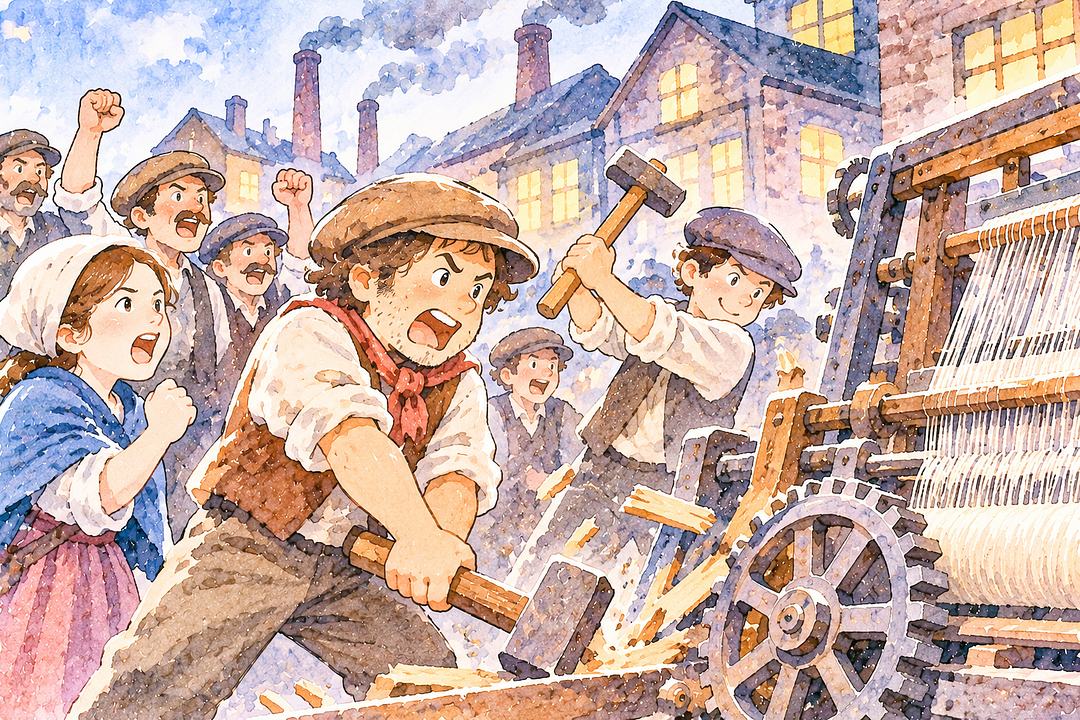
Around 50 years after the Industrial Revolution began, between 1811 and 1816, angry workers across the Midlands and northern England — including Nottinghamshire, Yorkshire, and Lancashire — began destroying factory machinery.
This became known as the Luddite movement.
I think they absolutely had reasons to be angry.
But the machines did not stop.
The government’s response was severe.
In 1812, a law was introduced making machine-breaking punishable by death.
The poet Lord Byron opposed it in Parliament, but the direction of events did not change.
In Lancashire, eight people were sentenced to death and 13 were transported to Australia.
The military was also deployed, and the movement was eventually suppressed by force.
On the other hand, some people completely transformed their lives during the exact same period of change.
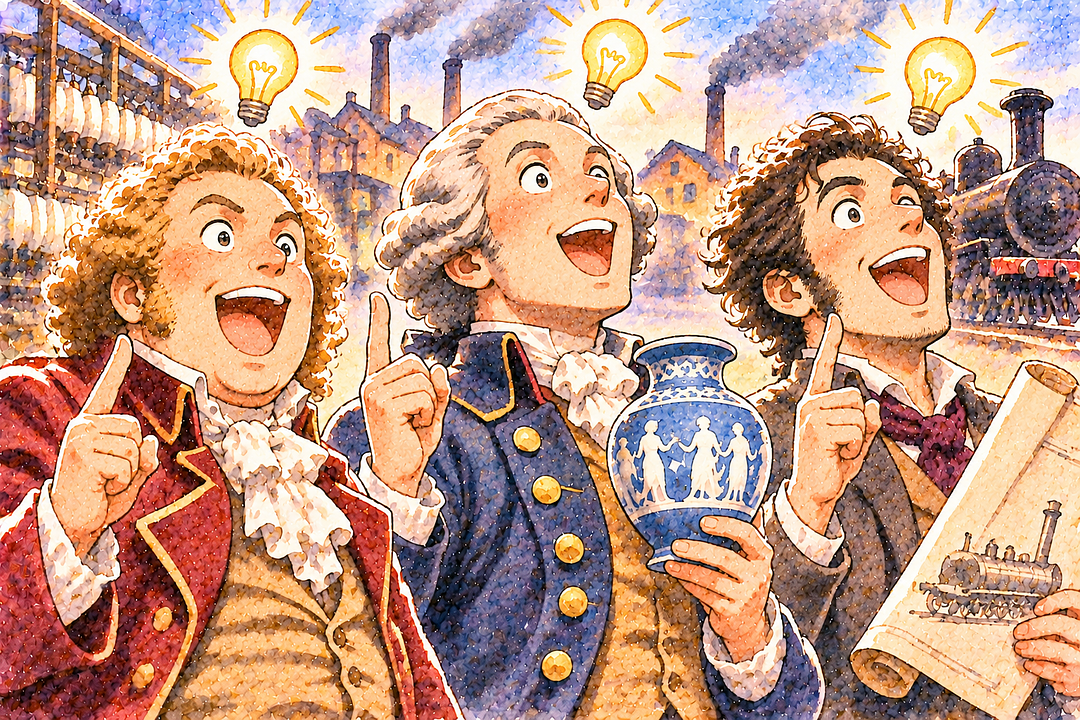
I want to introduce three of them.
I think their stories can offer some positive hints to those of us today who come from all kinds of different backgrounds.
George Stephenson
Born 1781, North East England
Most active: 1810s–1840s
About 50–80 years after the Industrial Revolution began.
He was born into a coal-mining family and could not attend school.
He could not read or write until he was 18, so he paid to attend night school and educated himself.
He made shoes and repaired clocks to earn extra money while continuing to work with machinery in the mines.
His turning point came around the age of 30.
He successfully repaired a troublesome mine pump, and the mine owners recognized his skill.
He was put in charge of all the machinery at the mine.
His annual salary:
£100.
Later, he developed a safety lamp for miners, and local businessmen awarded him £1,000.
Ten years of his annual salary.
Pretty incredible, right?
From there, he went on to build steam locomotives and became a major figure in railway engineering.
The track gauge used by many railways around the world today is based on the gauge he used.
Richard Arkwright
Born 1732, North West England
Most active: late 1760s–1790s
About 10–30 years after the Industrial Revolution began.
He originally worked as a barber and wigmaker.
Someone at the time described him as:
“a poor man worth only £5.”
Yet he went on to introduce a water-powered spinning machine and helped establish the factory system — large numbers of people gathering at fixed times to work.
Eventually, he was even knighted.
But many children also worked in his factories.
We should look properly at the shadows behind the success too.
Josiah Wedgwood
Born 1730, the English Midlands
Most active: 1760s–1790s
Almost exactly alongside the beginning of the Industrial Revolution. He opened his own workshop in 1759.
He was born into a family of potters.
His father died when he was nine, and he began working alongside his older brother.
His father had promised him an inheritance of £20.
In the end, he never received it.
Smallpox left him with problems in one leg, making the heavy physical work of operating a potter’s wheel difficult.
So instead, he devoted himself to researching how pottery was made and finding better ways to sell it.
He experimented repeatedly and standardized the quality of his products.
Catalogs.
Money-back guarantees.
Free shipping.
He was already using sales methods that look like modern online shopping — in the 18th century.
Next level.
And of course, the thing you start wondering is:
Once all that hard work paid off, how much did they actually make?
Very few records of annual income from that period remain.
So instead, I compared the wealth they had when they died.
Richard Arkwright
Born 1732 / died 1792 / age 59
Starting point: A barber said to possess only £5
Wealth at death: About £500,000
Estimated modern value: More than £200–300 million
About US$270–400 million or more
Josiah Wedgwood
Born 1730 / died 1795 / age 64
Starting point: A £20 inheritance he never received
Wealth at death: About £500,000–600,000
Estimated modern value: More than £200 million
About US$270 million or more
George Stephenson
Born 1781 / died 1848 / age 67
Starting point: A young miner who could not read or write until age 18. Around age 30, he was promoted to a position paying £100 a year.
Wealth at death: No exact record. He built wealth through railways and coal mining and purchased land and a large estate.
Estimated modern value: No record
Modern values can vary enormously depending on the method used for conversion.
Here, I converted the pound estimates given in the sources into US dollars using an exchange rate of roughly £1 = US$1.35, based on the rate in early November 2026.
So these are only rough estimates.
Still:
people who started with £5 or £20 ended up with wealth worth hundreds of millions of dollars in today’s money.
Mind-blowing.
The Industrial Revolution in Growth Rates
I want to look at some numbers to see just how enormous the Industrial Revolution really was.
In Britain, for roughly 400 years between around 1250 and 1650, per-person economic growth was about:
0.07% per year.
Almost zero.
After the Industrial Revolution, by around 1850, that accelerated to roughly:
1% per year.
About 14 times faster.
From there, economic growth continued globally.
Over the 200 years from 1820 to 2020, average world income increased by about 13 times.
That is roughly 1,200% growth.
So what about now?
……Continue reading in the Member space 🔐💼 Work & Workplace Topics 🗾 🙏
#📝 Notes on Work from the Front Line #2: Looking Back at the Industrial Revolution 🚂